Mills · pisani, kutani, pelne
For the mill: every sack on a token, every fee in the books.
Customers bring wheat to grind, paddy to husk, mustard to press. Accura gives each job a numbered token, keeps their grain apart from your own stock, takes the fee in money or in kind, and adds up the day — machines, by-products and all.
Figures show a sample mill.
How a mill day flows in Accura
From the first sack on the scale to the last token collected.
A sample day at Bhandari Mill in Banepa in paddy season — pisani, kutani and pelne side by side, and the mill’s own atta at the counter.
-
Morning · grain arrives
Weigh it in, give a token
Hari Thapa brings 2 muri of wheat from Dhulikhel. Enter it in muri, pathi, mana, kg or quintal — with how many kg a pathi of this grain weighs — count the sacks, pick the machine and print the 80 mm token slip.
In Accura: Mill → Receive grain
Opens a job with the next token of the fiscal year and works out the kg.
- The customer’s grain — not your stock
-
On the machine
Chakki, huller or expeller
The job moves to Processing on Chakki 1. The board shows every open token — received, processing, ready — so nobody hunts for whose sack is whose.
In Accura: Mill → Jobs
Status only moves forward; a cancelled job keeps its token number.
- The customer’s grain — not your stock
-
Ready
Flour out, chokar and bhus weighed
Weigh what came out — flour, rice or oil — and the by-products: chokar, bhus, pina, each returned to the customer or kept by the mill. What comes out can never be more than what went in.
In Accura: Mill → job → Ready
Keeps the weight out, the wastage and every by-product on the job.
- The customer’s grain — not your stock
-
Collected
The fee: per kg, per sack — or bhag
Charge per kg or per sack in cash, QR or on udharo: that is a normal VAT bill of service lines. Or keep a share of the grain as bhag — it goes into the mill’s own stock at its value.
In Accura: Mill → Take fee
A money fee is a bill with its IRD number. Bhag is grain in, and milling income in the books.
- Sales book · VAT 13 %
- Cash
- Udharo +
- Stock in
- Profit & loss
-
Through the day
Hours, units and diesel per machine
Log each machine’s running hours, NEA units or litres of diesel for the day — the huller on diesel, the chakki on the meter.
In Accura: Mill → Machines
Keeps a daily log per machine for the day’s summary.
- The mill’s day
-
Evening
The day, on one page
Pick a BS date: jobs received, made ready and collected, kilos by grain, fees in money and in kind, by-products kept and returned, machine hours.
In Accura: Mill → The day
Adds it all up from the jobs, the fee bills and the machine logs.
- The mill’s day
- Day Book
-
The counter
Your own atta, rice and oil
The mill’s own flour, Sona Mansuli and mustard oil are ordinary stock at the counter — quick-tap tiles, VAT bills, udharo for the school hostel, day close.
In Accura: Counter sale
Sells your goods like any shop; the customers’ grain never mixes into your stock.
- Stock out
- Sales book · VAT 13 %
- Cash
Good to know
Paddy season, forty sacks a day
After the Kartik harvest the huller runs all day. Every sack has a token, so nothing gets mixed up — or argued about.
Tokens by fiscal year
“Token 412” finds the job weeks later. Numbers restart each Shrawan and are never reused.
Close the day
Count the drawer note by note against the day’s fees and counter sales.
VAT and the IRD books
Fee bills and counter bills land in one sales book by BS month, ready for your accountant.
Real screens from a sample mill
Tokens, the job board and the day — as the mill sees them.
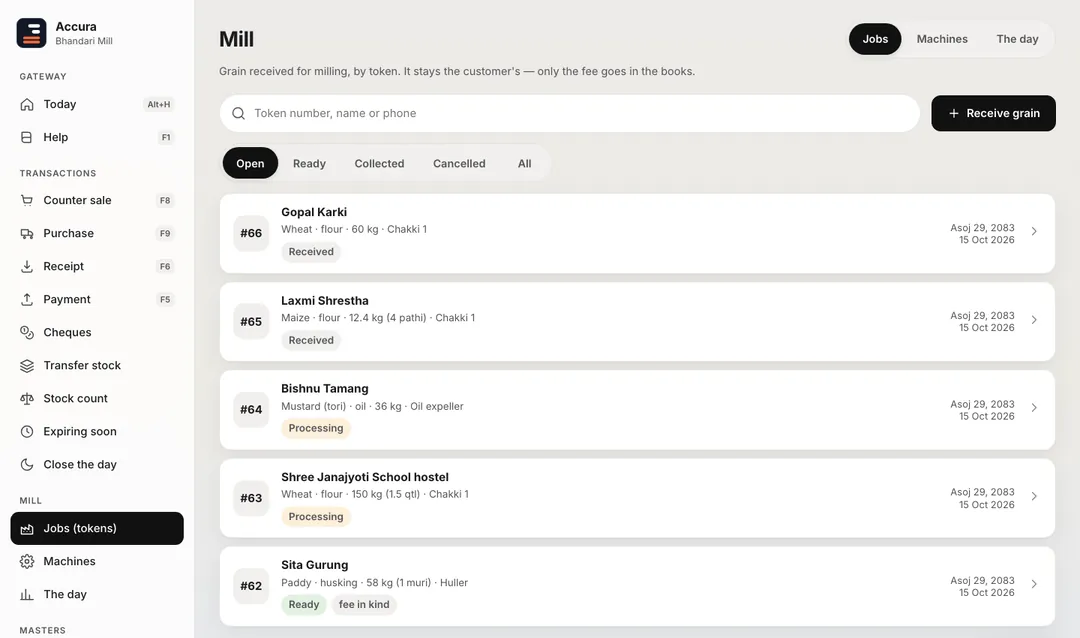
Mill → Jobs
Every open token on one board
Who brought what, how much (2 muri = 58 kg of paddy, 4 pathi of maize), on which machine — received, processing or ready.
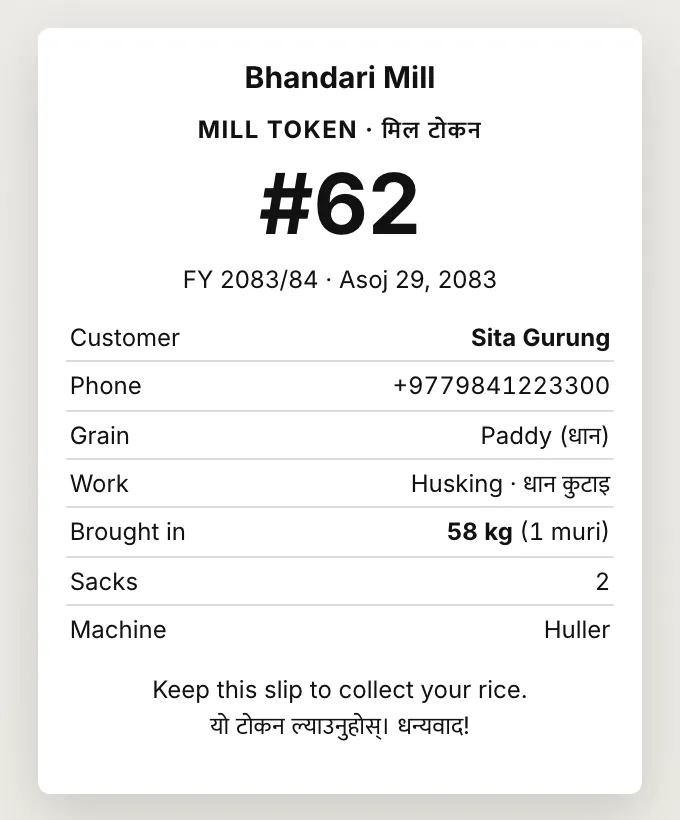
The token slip
80 mm, in English and Nepali
Printed when the grain comes in: token number, fiscal year, BS date, the customer, grain, work, weight in kg and muri, sacks and machine. “Keep this slip to collect your rice.”
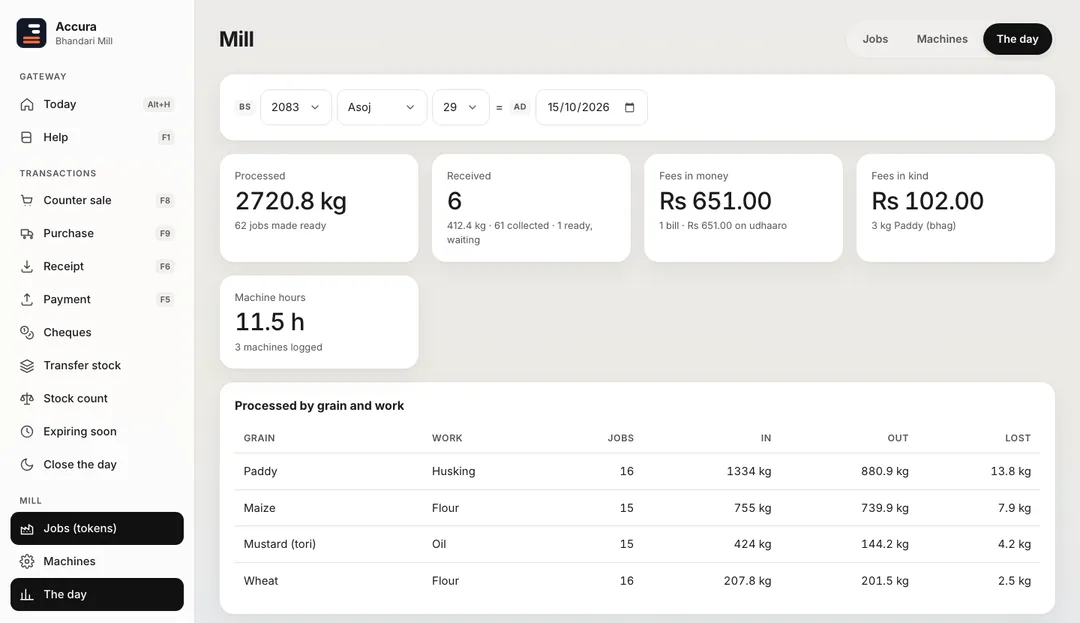
Mill → The day
Kilos, fees and machines for any BS date
Processed by grain and work, fees in money and in kind (bhag), by-products and machine hours — added up from the jobs.
Sample data Real Accura screens, captured from sample shops with made-up names and figures.
What a mill needs
Made for the mill floor, sack by sack.
- Available
A token for every job
Numbered per fiscal year, so “token 412” finds the job weeks later. An 80 mm slip prints when the grain comes in.
- Available
Weights the way you measure
Kg, quintal, muri, pathi or mana — with the kg per pathi entered for that grain, on that job.
- Available
Fees per kg, per sack or as bhag
Take the fee in cash, QR or on udharo — or a share of the grain or flour. A money fee is a normal VAT bill; a share goes into stock at its value.
- Available
Chokar, bhus and pina
By-products by weight, returned to the customer or kept by the mill — and what came out never more than what went in.
- Available
Machines and the day
Chakki, huller and expeller: hours, electricity units and diesel each day. “The day” adds up jobs, kg, fees and machines.
- Available
Sell your own atta, rice and oil
Your own goods are ordinary stock items at the counter — with VAT, udharo and day close like any shop.
The day at the mill
Jobs, kilos, fees and machines — on one page.
Pick a BS date and see what came in, what was made ready, what was collected and what is still waiting — with the fees in money and in kind, by-products kept and returned, and each machine’s hours.
- The customer’s grain is never counted as your stock — only the fee and your share are.
- Status goes forward only: received → processing → ready → collected.
- A cancelled job keeps its token number; it is never reused.
And what every business gets
- VAT 13 % bills with BS dates, IRD bill numbers, the sales and purchase books
- Udharo with credit limits, receipts against bills, cheques
- Stock across the shop floor, godowns and branches
- Tally-style books — Day Book, Trial Balance, P&L, Balance Sheet
- Close the day: count the drawer note by note
- A counter PC that keeps billing when the internet drops
- Staff salaries by BS month, advances, SSF and TDS — private from the counter
- Cash flow, and ageing of what customers owe you and what you owe suppliers
- Items and parties in from Excel; reports out to Excel or PDF
Other businesses on Accura
- Kirana & martsPackets, loose kilos, expiry dates
- Hardware & paintsBags, lengths, contractors on credit
- PharmacyStrips, batches and expiry
- Mobile & electronicsPhones, accessories, repairs
- Clothing & footwearSizes, labels, festival seasons
- Wholesale & distributorsOrders, challans, price levels
- Make & sellRecipes, production, made to order
- ServicesService bills, jobs and advances
Open your business in Accura today.
Start on the free plan with one counter. Add your items, your udharo and your team when you’re ready — every feature is there from the first day.